
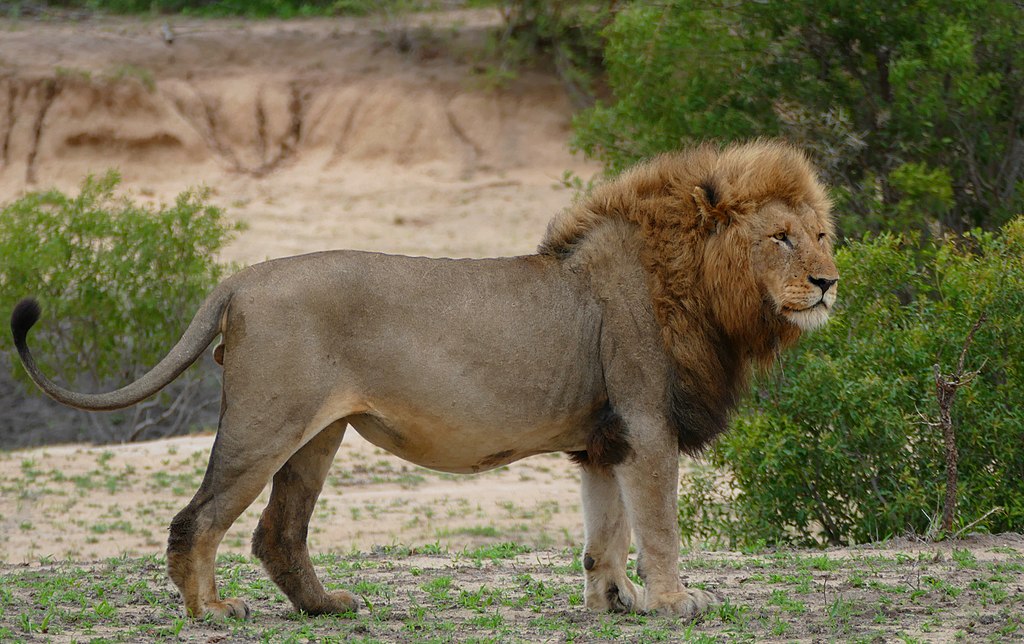
I grew up watching and reading everything I could find about African wildlife. I read National Geographic, International Wildlife, Smithsonian. I sat in rapt attention in front of my little black and white t.v. and listened to hours of wildlife programming. Back in the 1970’s and early 80’s it wasn’t as sensationalistic as it is today on cable channels “Animal Planet” and “Nat Geo” You had a monotone narrator, spouting scientific facts. My Mother would often roll her eyes, when she overheard the tell tale bland cadence.
African animals such as elephants and lions, figured prominently in my sketch books. I remember being bummed out to learn there were no poisonous snakes in my region. I was a child of suburbia. Megafauna were in short supply on my daily hikes. The most I could hope to see was a snapping turtle lurking beneath a culvert, or a fleeting glimpse of a dumpster diving racoon or opossum.
Large African animals, such as majestic lions or toothy crocodiles are so evocative and charismatic. Sub urbs can be overly sterile and bereft of close encounters with nature.
In one sense, I, as an American, and an “animal lover” was practicing a type of animism, drawing strength and inspiration from African animals. They are part of our culture. They figure prominently in Children’s books. We imprint on them starting from a young age.
This probably explains the outrage, when pictures of rich white people with dead African wildlife Trophies go viral. These strike people as the murdering of their childhood story book characters. But its not just childhood programming, its adult programing as well. People feel a kinship with African animals. Pictures and stories of them fill our Facebook and Instagram feeds. It feeds our souls.There is a sense of loss in the civilized psyche and a desire to reconnect. People feel protective of animals, they may never see in real life. We just want to know, that some where, there are huge animals, living wild and free, as We commute to work on the free way and subject ourselves to the daily grind.
There is an urban/rural cultural divide in this country around topics related to animal welfare. Rural people are closer to traditions of farming and hunting, closer to the reality of what it means to kill animals for food. In contrast urbanites eat meat from the deli and the only human-animal relationship they have is with pets, which is a surrugate parent/ child relationship. So its no wonder pictures of dead African animals bring out protective maternalistic instincts. Hunters, in the US, however, have a long history as conservationists.
So whether, we hunt, or enjoy wildlife in some other way it seems to be that we as Americans/Westerners see ourselves as “stake holders” in the fate of African wildlife. I won’t debate the morality of this. We are after all citizens of the globe, in the sense that we share the same biosphere. The health and biodiverity of the planet effects us all. Also there are many intangible qualities, wildlife, brings, such as inspiration, a sense of wonder, etc.
Be that as it may, what often gets left out of the narrative in the conservation of African wildlife, are Africans, themselves, namely, black Africans; the indigenous people of Africa. If we westerners are stakeholders, should not black Africans be stakeholders as well, even more so?
In the narratives we often receive from large conservation organizations, indigenous African’s are mentioned only as “poachers” playing the role, of storybook villains.
As I began to research this topic, I uncovered some startling things.
First of all The legacy of colonialism and racism in African Conservation.
Historically, Black Africans such as the Masai were kicked off of land to create reserves such as Serengeti National Park. Today, Most of the Large African Parks are off limits to local Black Africans.
There is an historical precedent for the African National Park system which goes back to the Park system in the United States involving such figures as Theodore Roosevelt, John Muir. A little known fact is that Native Americans were evicted from places such as Yellowstone and Yosemite. This practice was continued in African National Parks as well.
Second of all, I discovered from my research, that “wildness areas” and National Parks throughout the globe, were not in fact “untrammeled by man” but most often originated from cultivation and thousands of years of land management by indigenous people.
Native Americans, shaped the Great plains, creating mosaics of forest and grassland through controlled burns, and the spreading of edible plants, and fruiting trees.
The same has been observed in Amazonia:
“Many present Amazon forests, while seemingly natural, are domesticated.”
Amazonians created fish ponds, orchards and Fertile soils using charcoal.
The same can be said for the Masai people of East Africa, as well.
“All definitions of wilderness that exclude people seem to me to be false. African ‘wilderness’ areas are racist because indigenous people are being cleared out of them so white people can go on holiday there.” » Jay Griffiths
In fact, according to “Survival International” this appears to be a trend of tribal people throughout the globe, even today:
80% of the most biodiverse areas on Earth are home to indigenous and tribal peoples
Historically Conservation and Indigenous people have been in conflict over land use, but this may be changing.
The conflict began in the bucolic stillness of Yosemite valley in the eastern Sierra Nevada mountains of California. From the middle of the 19th century until 1914, when Yosemite became a national park, a concerted and at times violent effort was made to rid Yosemite of its natives, a small band of Miwok Native Americans who had settled in the valley about 4,000 years ago.
During the same period, most of the major parks created in America – notably Yellowstone, Grand Canyon, Mesa Verde, Mount Rainier, Zion, Glacier, Everglades and Olympic – repeated the Yosemite example by expelling thousands of tribal people from their homes and hunting grounds so that the new parks could remain in a “state of nature”. This practice of conservation was exported worldwide, becoming known as “the Yosemite model”. Refugees from conservation areas have never been counted; they are not even officially recognised as refugees. But the number of people displaced from traditional homelands worldwide over the past century in the interest of conservation is estimated to be close to 20 million, 14 million of them in Africa alone.
Most of the Large Conservation organizations such as the WWF follow, the older colonial model of conservation, excluding the local indigenous population from land management and decision making. Instead, partnering with Agribusiness, Industrial conglomerates and Mining Corporations.
A recent trend, which many experts find problematic, is the hiring of foreign military personnel and private security forces to train rangers to hunt down poachers. Though some poachers belong to organized criminal syndicates, many are poor blacks just trying to support and feed their familes. Recently a corporation called “VETPAW” posted sexy sensationalist photos of American Afghanistan and Iraq veterans, hired as anti-poaching mercenaries such as this woman . Due to stating their mission as “killing bad guys” and other public relations SNAFU’s VETPAW was later kicked out of Tanzania.

A recent article in Newsweek paints a disturbing scene:
Two black men slink through tall buffalo grass on the trail of a rhino. One shoots, the massive beast falls, and the shooter’s partner rapidly slices off its horn. The two men then flee on foot, leaving behind a grotesquely mutilated but possibly still living rhino. That horn will net enough money to buy a car and TV, as well as send their children to high school. And so they run, racing through grasslands where hippos and elephants frequently kill foraging humans, as lion and leopard prowl behind rocks. Their goal: getting over one of the great fences that delineate public and private land before white mercenary soldiers with night-vision goggles hunt them down and kill them.
By being shut out of the land, the local people have no stake in conserving these animals.
Local people don’t stigmatize poachers the way they are vilified in the West, often seeing them as Robin Hood type figures. Here is a quote from the above linked article in Newsweek. It is from a brother at the funeral of a poacher.
“Our grandfathers were kicked out, and now we can’t even step in because it’s a game reserve,” Mabuse said. “Our government and foreign countries should plead for us to be able to go inside, because those animals, first of all, are not theirs—they are God’s creation. Today, we are being killed like animals, which makes me wonder: Which life is more important, ours or the animals? It seems like the animals are now more valuable than human life. Because we are poor. There is no work, and people are going in there to try and put food on their tables. They are being killed…. Thousands have been killed in that park. And only hundreds of animals.”
Its difficult to get estimates on the number of poachers killed but at least 500 have been killed in the last three years from neighboring Mozambique.
Conservation Organizations often portray the situation in Good vs. Evil terms through simplistic infographics ignoring the link between poaching and poverty
So what is the solution? One solution would be to make the sale of rhino horns illegal, and to work to curtail demand for these horns in Asia. But that is not likely to gain much support from white land owners in South Africa, such as this Man owner of the largest Rhino farm in South Africa. When Rhino sales were declared illegal in South Africa in 2009, he sued the government and won. Now Rhino horn sales in South Africa are again legalized.
Whole communities, not just select individuals, need to be stake holders in order for conservation to be sustainable. This is called “Community Based Natural Resource Management” or (CBNRM)
I would like to highlight the following organizations which promote these practices:
Survival International is an organization which “..exist(s) to prevent the annihilation of tribal peoples and to give them a platform to speak to the world so they can bear witness to the genocidal violence, slavery and racism they face on a daily basis. By lobbying the powerful we help defend the lives, lands and futures of people who should have the same rights as other contemporary societies.”
They have conducted several studies demonstrating how indigenous people preserve biodiversity through their cultural ties to the land. This is their message:
It’s time to change conservation
For tribes. For nature. For all our humanity.
Conservation must accept the growing proof that tribal peoples are better at looking after their environment than anyone else. The huge sums spent on conservation must be given to the cheapest solution – upholding tribal peoples’ land rights.
Just Conservation is “A network for all who care about the conservation of our world and who want to see it achieved with justice, compassion, dignity and honesty.” They feature articles addressing the challenges of balancing conservation and respect for indigenous communities and human rights. Some recent articles include:
Too Scared to go into the forest
Wildlife Conservation Society partners with loggers in the Republic of Congo
Kenya: Conservation and Indigenous peoples’ rights – not a zero sum game.
Another Organization I would like to highlight is the Climate and Land Use Alliance.
The Alliance makes grants and engages key stakeholders, policy-makers and experts to explore and develop solutions that:
- Reduce greenhouse gas emissions from deforestation, forest degradation, and unsustainable agricultural practices
- Develop, implement, and finance low-carbon growth
- Protect the land and resource rights of indigenous peoples and rural communities
- Conserve natural landscapes
- Increase the efficiency and sustainability of agricultural practices
They have created a bibliography of “of studies which show how community tenure over forests by Indigenous peoples, increases forest cover and biodiversity.
Our approach differs from that of other organisations in that it is committed to both human rights and environmental protection. Instead of purchasing land or conserving forests purely for their biodiversity value, the RFUK promotes the establishment of community rights over rainforest lands, tackling the root of the problems related to deforestation and paving the way for local people to benefit fairly from the use and protection of forest resources.
Indigenous peoples’ participation as well as their knowledge of the local ecology are now recognised as the most effective way of protecting the environment. We have been helping indigenous and local communities to protect millions of hectares of rainforest over the last 28 years and we will continue empowering forest people to secure lands and sustain lives for future generations.
Only by helping Indigenous people claim their human rights can we preserve biodiversity and protect endangered species.


